
We recognize that your time is valuable—and there are lots of decisions to be made pertaining to your next project. When deciding where to buy decouplers and over-voltage protectors, it is important to consider more than the price listed on a sales sheet.
Our goal at Dairyland is to make a safer world by solving complex problems through innovative product design. From our beginnings solving stray voltage issues on dairy farms, to our global impact in the pipeline and high-power industries, we have over four decades of experience building rugged, reliable products that last.
We’ve created the following resource to aid you next time you need a decoupler or over-voltage protector for your project.
 |
How can I know if the decoupler I purchase will perform as specified?
We work tirelessly to deliver our customers the safest, most reliable products on the market. Integrity, safety, and reliability are part of everything we do at Dairyland—it’s in our DNA. We have full confidence that a properly specified product will perform as intended for years to come, because each one of them is thoroughly tested to confirm that they work as intended. But you don’t have to simply take our word for it—you can rely on our third-party certifications to independently confirm that our products do what we say they do.
Learn more about the importance of Third Party Certifications.
Do Dairyland products ever fail? What happens if they do?
Dairyland’s product failure rate is calculated at 0.01%. In fact, our products fail so rarely that in our 40+ years of business, only a handful of failures have been reported.*
Beyond that, our products are designed to be “fail-safe,” a standard that Dairyland set and introduced to the corrosion prevention industry. This means that during an over-voltage event, or in the very rare case of product failure, your device is designed to short to ground, safely passing any harmful current away from workers and/or equipment.
At the end of the day, when you invest in Dairyland products, you’ll receive premium decouplers and over-voltage protectors that are suited for extreme conditions, resulting in protection for your equipment and safety for your personnel.
*In the unlikely event that one of our products fails, please contact us (TechSupport@dairyland.com or 608-877-9900) to first discuss safely removing it from service. We will then work with you to determine the next steps in replacing the device.
What maintenance do your products require to keep my assets protected?
This one is easy—the answer is none! Dairyland decouplers and over-voltage protectors require no regular maintenance.
Our customers can rest assured that their Dairyland products meet all critical performance requirements, ensuring product performance, longevity, and safety, while also saving you valuable time—and money.
While not necessary, you may choose to test the functionality of your device. Here are some helpful resources to get you started: How To Test A Decoupler — Direct Test video, Indirect Testing article, & Direct Testing article.
What happens if I run into a problem or have questions when installing the product?
Call us (608-877-9900) or email us (TechSupport@dairyland.com). During our normal business hours, you will always be able to reach a real person within the first few rings.
Here at Dairyland, we pride ourselves on being a reliable resource and offer complete technical guidance on applications and products associated with isolation, grounding, over-voltage protection, and other related issues. Our team has an in-depth knowledge of Dairyland product offerings and industry solutions. We ensure your technical questions, application challenges, or product inquiries are thoroughly researched, and that you know how to proceed.
If you have a question or a problem you’re struggling to solve, give us a call. We’re here to help.
 |
Does Dairyland offer a product warranty?
Yes! Currently, Dairyland offers a 5-year warranty on all PCR, SSD, PCRH, OVP and OVP2 products, while our ISP and PCRX products both have a 2-year warranty from the date of invoice. For warranty details on Dairyland’s other product lines, please reach out to our team.
In Conclusion
The end result is clear to our customers around the world: we build rugged, reliable products that you can trust to perform. As we’ve done for the last 40 years, Dairyland will continue to pursue innovation, working efficiently to serve the needs of our customers. If a solution to your problem does not yet exist, we’ll work to find one.
The following video demonstrates the direct test method for ensuring proper functionality of your PCR, PCRH, PCRX, or SSD.
For more detailed information, visit our direct testing knowledge base article.
Q U I C K L I N K S
What decoupler ratings do I need for AC Mitigation?
Can one decoupler be connected to multiple parallel insulated joints?
My valve site shorts the CP system. What do I do to solve this?
How can decoupler placement be allowed in series in a code covered electrical grounding conductor?
What are my options for separating station CP from the power company?
Can I connect a decoupler in the neutral connection to isolate my station from the power company to isolate my CP system?
What’s the difference between Dairyland products and spark gaps/lightning arresters?
Dairyland technical support personnel work tirelessly to ensure all your needs are met when it comes to products, applications, and general support. While we cannot exhaustively answer every question in this format, we want to put the knowledge back into your hands as often as possible. Therefore, below are some frequently asked technical questions that we receive, along with a corresponding answer and other helpful resources where applicable. Should your concern fall outside the scope of these simple answers, please do not hesitate to contact our tech support team via phone (608-877-9900) or email (TechSupport@dairyland.com).
What decoupler ratings do I need for AC Mitigation?
Every AC mitigation project is unique, so here are steps to determine what is needed: First, collect data from testing or studies done on the pipeline, such as AC fault current, AC steady -state current, and any classified hazardous areas along the route. The steady-state AC current rating selected should be adequate for the range of values that can occur daily or seasonally. Several Dairyland product families have a standard 45 A-rms rating, which is normally adequate. The PCR product family has an optional 80A-rms rating. The AC fault current rating will be determined from the mitigation design report, or in consultation with Dairyland staff. However, a common AC fault rating used is 5kArms (30 cycles, 50/60Hz). Lastly, determine the blocking voltage threshold required. To select the appropriate threshold, it will depend on the type of grounding material used. For copper grounding, select the -3V/+1V and the 2V/+2V for zinc grounding.
All product ratings are listed on the Dairyland website.
There are a number of accessories that can be helpful for an AC mitigation project, and are located here. Typical accessories are a pedestal to enclose the product and an isolation switch to safely disconnect a decoupler during surveys.
Additional Resources:
AC Mitigation Application Guide
“Safety Considerations In AC Mitigation Applications”
“How Do I Know Which Dairyland Product To Use?”
Can one decoupler be connected to multiple parallel insulated joints?
You can use one Dairyland decoupler if joints are closely spaced, for example within 2 feet. Lead lengths must be kept as short as possible for optimum over voltage protection for lightning. Longer leads adds inductance to the connection path, which produces large voltage drops for fast rising waveforms.
My valve site shorts the CP system. What do I do to solve this?
To effectively isolate a motor operated valve, a decoupler can be connected in series with the equipment grounding conductor and isolate one side of the metallic conduit to prevent a bypass. This decoupling point can be anywhere between the panel and the valve motor, noting hazardous classification within the station.
One method to address multipole shorts uses a polycarbonate enclosure to house the decoupler and create an open point in the conduit. Once all shorts to ground have been cleared, a Dairyland decoupler can be connected across the open points using a grounding hub on the incoming and outgoing conduit, placing it in series in the equipment grounding conductor, and the sheath or bonding conductor of any communications cable. Connect the positive terminal of a decoupler towards the electrical panel side or the non-cathodically protected side. The negative terminal should be connected to the cathodically protected side or the motor operated valve.
How can decoupler placement be allowed in series in a code covered electrical grounding conductor?
In the US National Electrical Code, NFPA 70, section 250.4(A)(5) regarding an effective ground-fault current path, requires: “Electrical equipment and wiring and other electrically conductive materials likely to become energized shall be installed in a manner that creates a permanent, low-impedance circuit facilitating the operation of the overcurrent device or ground detector for high-impedance grounded systems. It shall be capable of safely carrying the maximum ground fault current likely to be imposed on it from any point on the wiring system where a ground fault may occur to the electrical supply source.”
The key is that Dairyland decouplers were evaluated, tested, and certified by Underwriters Laboratory (UL) as meeting the effective ground-fault current path requirements, as the devices were permanent, low impedance, fault-rated devices that fail safe, meaning fail shorted. Thus, they do not compromise the grounding system whether they are functional or failed and are therefore allowed in the ground fault current path.
Once the requirements of the ground fault current path are met, a listed decoupling device can be used as section 250.6 (E) states: “Where isolation of objectionable DC ground currents from cathodic protection systems is required, a listed AC coupling/DC isolating device shall be permitted in the equipment grounding path to provide an effective return path for AC ground-fault current while blocking DC current.”
The Canadian Electrical Code, CSA C22.1 in section 10-500 defines effective grounding, similar to the NEC, and in section 10-806(1) allows certified devices to be installed in grounding conductors.
Dairyland decouplers meet these requirements and have been used in equipment grounding conductors since 1996.
Additional Resource: “The Role of DC Decouplers with Cathodic Protection Systems”
What are my options for separating station CP from the power company?
Grounded electrical systems can bond structures with CP to the local grounding system and ultimately to the power company grounding system due to the two grounding systems being connected at the transformer. A complicated facility receiving power can have multiple possible approaches to solving shorted CP systems.
- Decouple every bond to local facility grounding (can be extremely challenging due to so many ground connections, valves, electrical equipment, etc.)
- Decouple the facility and utility grounding systems at the disconnect panel.
- Decouple the facility and utility grounding systems at the utility transformer.
Decoupling at either the disconnect panel or at the utility transformer accomplishes the same CP isolation if done correctly. If performed at the disconnect panel, your electrician can accomplish this in conjunction with the CP staff, but every station is likely built differently, and each facility will need to be examined for the source of the short. The typical situation is that the incoming neutral, which is already bonded to the power utility, is then grounded in the disconnect panel, and we have already established that your CP system is tied to the facility grounding system. Usually, the decoupler is installed in series with the electrical grounding conductor right after neutral is bonded to the ground bus at the panel to accomplish CP isolation up to that point within the station.
An alternative is to install the decoupler at the transformer between primary to secondary neutral bond. The decoupler is installed in series with this primary to secondary neutral bond and removing one of the tank or case bonding straps to prevent a bypass. This is a highly standard location that can uniformly be addressed, but it does involve an outside party – the power company.
Additional Resources:
Decoupling From Utility Grounding Systems Application Guide
DC Decoupling from Utility Grounding Systems White Paper
Can I connect a decoupler in the neutral connection to isolate my station from the power company to isolate my CP system?
No. A decoupler cannot be placed in series with the neutral connection because it is a load carrying conductor and a decoupler is not approved to be installed there. Decouplers are certified and approved to be installed in series with the electrical grounding conductor, which is only meant to carry fault current and not load current.
Dairyland decouplers meet the standards per UL and C-UL for Effective Ground Fault Current Path per the following:
- NFPA 70 (US National Electric Code – NEC): Article 250.4(A)(5)
- CSA C22.1 (Canadian Electric Code, Part I): 10-002
What’s the difference between Dairyland products and spark gaps/lightning arresters?
For a spark gap or lightning arrester to trigger, voltage must build to a very high value, typically hundreds of volts. Dairyland products have a very low and safe voltage threshold. This provides much better protection for personnel and equipment. Spark gaps or arresters generally are not rated for any notable value of AC fault current and usually fail during AC fault events. Dairyland products have high AC fault current capability ranging from 1.2 KA to 15KA and can go even higher if needed by using multiple devices in parallel, but that is another conversation.
Additional Resource: Over-Voltage Protection: The Critical Differences Between Spark Gaps and DC Decouplers White Paper
Dairyland is committed to providing reliable information on products, applications, and services. Don’t see your question answered above? Our tech support team is available during our normal business hours and can be reached via phone (608-877-9900) or email (TechSupport@dairyland.com).
Another helpful resource to reference is our recently published article: “Top-10 Questions About Decouplers”
Q U I C K L I N K S
What is the difference between a Decoupler and an Over-Voltage Protector?
When do I need a Dairyland Decoupler?
How do I test a decoupler to know if it is working?
What is the difference between a PCR and an SSD?
Which products are rated for hazardous locations?
How do Dairyland decouplers compare to competing technologies?
What polarity should be used to connect a decoupler?
What is a “voltage threshold”? And how do I know that my decoupler has the correct voltage threshold for my application?
What should the spacing between decouplers be for AC Mitigation applications?
How do I spec a product for an insulated joint?
Dairyland technical support personnel work tirelessly to ensure all your needs are met when it comes to products, applications, and general support. Below, we have compiled a list of frequently asked questions regarding Dairyland decouplers and their various applications. This resource will also guide you to related articles in our Knowledge Base for further reading.
Dairyland decouplers keep workers and valuable assets safe from AC faults, lightning, and induced AC voltage, all while optimizing cathodic protection systems. We hold ourselves to a very high Always Rugged standard to ensure Dairyland products meet all critical performance requirements, provide fail-safe operation, and address hazardous location needs to guarantee longevity and safety.
Our tech support team is available during our normal business hours and can be reached via phone (608-877-9900) or email (TechSupport@dairyland.com).
What is the difference between a Decoupler and an Over-Voltage Protector?
Decouplers (PCR, PCRH, PCRX, and SSD) are commonly used to isolate cathodically protected structures from other equipment grounding systems, enhancing the cathodic protection system’s performance. They also perform a function of safely grounding induced AC, fault current and lightning. Over-Voltage Protectors (OVP and OVP2) provide the same DC isolation and protection from fault current and lightning but are not designed to address induced AC current.
Therefore, the first question to ask when selecting a Dairyland product family is whether there is (now or could be in the future) any induced AC voltage present. Induced AC commonly occurs on structures near overhead powerlines. If the answer is yes, or if you are unsure, you should select a decoupler to address any present or future issues with induced AC.
Additional Resources: “What Are Solid-state Decouplers and How Are They Used?” and “Over-Voltage Protection: The Critical Differences Between Spark Gaps and DC Decouplers.”
When do I need a Dairyland Decoupler?
The short answer is that a decoupler can be used for a variety of purposes and applications. Most frequently, they are installed when it is desirable to isolate DC current (CP current) while simultaneously grounding AC fault current and lightning current.
DC Decouplers are commonly used for applications such as:
- Isolating electric equipment from grounding systems, while still meeting electrical codes for safety
- Insulated joint over-voltage protection
- Connecting a cathodically protected pipeline to an AC mitigation system
- Tying a cathodically protected pipeline to a gradient control mat
- Grounding of power cable sheaths/casings to substation grounding systems
- Separating a facility with CP from power utility grounding systems beyond the transformer
Additional Resource: “AC Mitigation and Cathodic Protection: How Decouplers Make a Difference”
How do I test a decoupler to know if it is working?
A simple, indirect way to test a decoupler is through a standard pipe-to-soil reading. If your test shows acceptable CP levels, then the device is functioning properly. Decouplers are designed to block DC current, therefore acceptable cathodic protection readings reflect an operational Dairyland device.
For more detailed testing, please refer to our website’s tech articles: “Indirect Testing” & “Direct Testing.”
What is the difference between a PCR and an SSD?
PCRs and SSDs provide the same functions, and the main differences are in the ratings, package size, and cost.
- PCR AC fault ratings: 3.7 kA, 5 kA, 10 kA, and 15 kA.
- SSD AC fault ratings: 1.2 kA, 2.0 kA, 3.7 kA, and 5 kA.
Dairyland’s SSD was created as a more compact unit some years after the PCR. They share AC fault current capabilities, but the SSD was developed primarily for handling lower AC fault conditions. These units have identical hazardous location ratings, suitable for Division 2 and Zone 2 locations. PCR enclosures have either a NEMA 4X (IP66) rating or an optional NEMA 6P rating. SSDs enclosures have an IP68 rating (similar to NEMA 6P) that is rated for submersion up to two meters.
Additional Resource: “What if Decouplers Didn’t Exist?”
Which products are rated for hazardous locations?
PCR, PCRX, SSD, and OVP2 are all rated for use in areas with a Class I, Division 2 or Zone 2 classification. Class I, Division/Zone 2 units are suitable for most common applications, and these are Dairyland’s most frequently used devices.
PCRH and OVP are rated for use in areas with a Class I, Division 1 or Zone 1 classification. These units can still be used in any application with lesser requirements, such as Class 1, Division/Zone 2 installations.
Additional Resource: “Understanding Hazardous Locations”
How do Dairyland decouplers compare to competing technologies?
As a corrosion professional, your ideal applications keep your personnel safe and your system running efficiently. As an installer, you want tech that is easy to install and is maintenance-free. No matter your position, we know you are looking for solutions that address your various needs.
There are several devices on the market that attempt to resolve one or more of these concerns. However, maintenance needs, limited lifespans, and safety concerns all come attached to their price tags. Dairyland decouplers offer a solution to all your CP isolation and over-voltage protection needs. Because of their proven reliability, Dairyland’s solid-state decouplers are the smart choice over other DC isolation devices. Long-term, you will save maintenance labor and material costs by installing Dairyland devices. You will also mitigate risk to your equipment and personnel.
In addition to manufacturing industry-leading products, we pride ourselves on providing reliable technical support. Contact us any time.
Additional Resources: “Dairyland Decouplers vs. Competing Technologies” and “Dairyland OVP Devices vs. Competing Technologies”
What polarity should be used to connect a decoupler?
In general, the negative terminal connects to the more negative structure, and vice versa. Therefore, generally the + (Positive) goes to the ground connection and – (Negative) goes to the structure with CP. Across an insulated joint, where one side has CP and the other is grounded, connect negative to the protected side, and positive to ground. For an insulated joint with CP on both sides, select a symmetrical device, which is typically -2V/+2V, and then polarity is irrelevant.
Additional Resource: “Polarity Matters – Labels On Your Decoupler”
What is a “voltage threshold”? And how do I know that my decoupler has the correct voltage threshold for my application?
A decoupler’s voltage threshold is the voltage range supported between its terminals before direct current conduction. This is different from the industry measurement of “structure to soil” voltage, which is measured to a reference cell. The key value to measure is the difference between the two points a decoupler would be connected (pipe and ground) and compare that value to the negative threshold value.
For example, if a pipe-to-soil reading of -2V were obtained, and the reading from a grounding system to the same reference cell was -0.3V, then the decoupler connected between this pipe and grounding system would be exposed to -1.7V, which is the difference between the two readings. This assumes that the standard practice was used with decoupler negative terminal connected to the more negative structure (the pipeline) and positive to the grounding system. If the decoupler had a -3/+1V threshold, we compare the -1.7V reading to -3V value and find it acceptably below that threshold. Note that a -2/+2V threshold would have worked fine in this example as well. If the measured value were above the threshold, then the decoupler would be in full conduction and not block CP current. Standard Dairyland decoupler thresholds cover most pipeline situations.
A specific case that should be examined is where proximity to a rectifier results in elevated pipeline voltage that could approach the decoupler threshold and in that case one might consider the 3, 4, or 6 volt negative threshold to address this.
Additional Resources: “Understanding Voltage Threshold Ratings” & “Voltage Threshold Simulator”
What should the spacing between decouplers be for AC Mitigation applications?
Studies and testing should be conducted to accurately place Dairyland units for optimum AC mitigation and over voltage protection. Mitigation consultants are available to perform software modeling for optimal AC mitigation. Dairyland does not perform AC mitigation planning or studies. However, when we talk to mitigation designers regarding spacing, we have found that they often space these every ½ mile, presuming no pipeline or powerline changes in between that would cause a voltage spike. For example, whenever the pipeline or powerline change position relative to each other there will be a change in the magnetic field and a resulting voltage rise there, and a decoupler will be located near that change. Don’t forget other pipeline features such as insulated joints in the right-of-way that should be protected with a decoupler, as well as casings. AC mitigation design is a specialized field, and there are many factors that affect a design.
Additional Resource: “Decoupler Spacing for AC Mitigation Projects”
How do I spec a product for an insulated joint?
First, determine whether steady-state AC is present on either side of the joint.
- If AC is present, use PCR, PCRH, PCRX, or SSD.
- If AC is not present, use OVP or OVP2.
It is safer to assume that AC is present or could be in the future. Situations where AC is not likely are limited to airport fueling systems, and insulated joints interior to large facilities. Use caution, as AC induction on pipelines may require decouplers (SSD, PCR, PCRH) applied to a series set of insulated joints to mitigate AC to a station grounding system, only then allowing other insulated joints within a facility to utilize other Dairyland devices such as the OVP or OVP2. Due to complexity of stations, it is best to consult Dairyland staff for guidance.
Second, if the joint is in a Class I, Division 2 location, use models PCR, SSD, or OVP2 (most locations are Div 2/Zone 2). If the joint is in a Class I, Division 1 location, only use models PCRH or OVP.
Third, once the correct decoupler or over-voltage device is selected, choose the correct voltage threshold based on data (DC levels) collected from the pipeline. Typically, the standard ratings of -3/+1 or -2/+2 V are adequate. The -2/+2 (“symmetrical”) rating can be used where CP is present on both sides of a joint, or for CP present on one side of the joint only. The -3/+1 is generally only used where there is CP on one side of the joint and the other side is grounded. Remember to connect the negative terminal to the more negative, or cathodically protected, side.
Additional Resource: “Over-Voltage Protection: The Critical Differences Between Spark Gaps and DC Decouplers”
Bonus Additional Resources Regarding the MEGA Rule:
- “PHMSA Mega Rule Explained and How Dairyland Can Help You“
- “Understanding the Mega Rule: Accurate Close Interval Surveys“
- “Understanding the Mega Rule: Interference Mitigation“
- “Understanding the Mega Rule: RMV Installation Best Practices“
Should you have an eleventh or twelfth question, do not hesitate to contact our team at TechSupport@dairyland.com.
Dairyland decouplers play a crucial role in protecting personnel and infrastructure in various applications, including AC mitigation systems. It is important for users to understand how a decoupler will interact with external currents used during certain maintenance processes, like line locating or current surveys, to avoid inaccurate readings or more severe complications.
Line locating is a key operation for the pipeline industry, used to locate buried pipelines before performing routine maintenance or construction activities nearby. To locate buried pipelines, a transmitter is connected to the pipeline and sends various frequencies through it. A receiver, commonly referred to as the locator, is then used to read the signal from these frequencies above ground. If the locator is directly above the pipeline, the signal shows it’s exact depth and location. When performing pipeline locating, accuracy is imperative to ensure safe digging and/or accurate reads when performing other testing on the pipeline such as ACVG, DCVG, CIS, etc.
When locating, anything that is in proximity—such as a water line—could cause the signal to jump off the pipeline and follow that neighboring structure. Because the signal travels through soil to reach the neighboring structure, some impedance occurs, resulting in a weaker signal. If the signal becomes weaker, the locator is no longer following the intended pipeline.
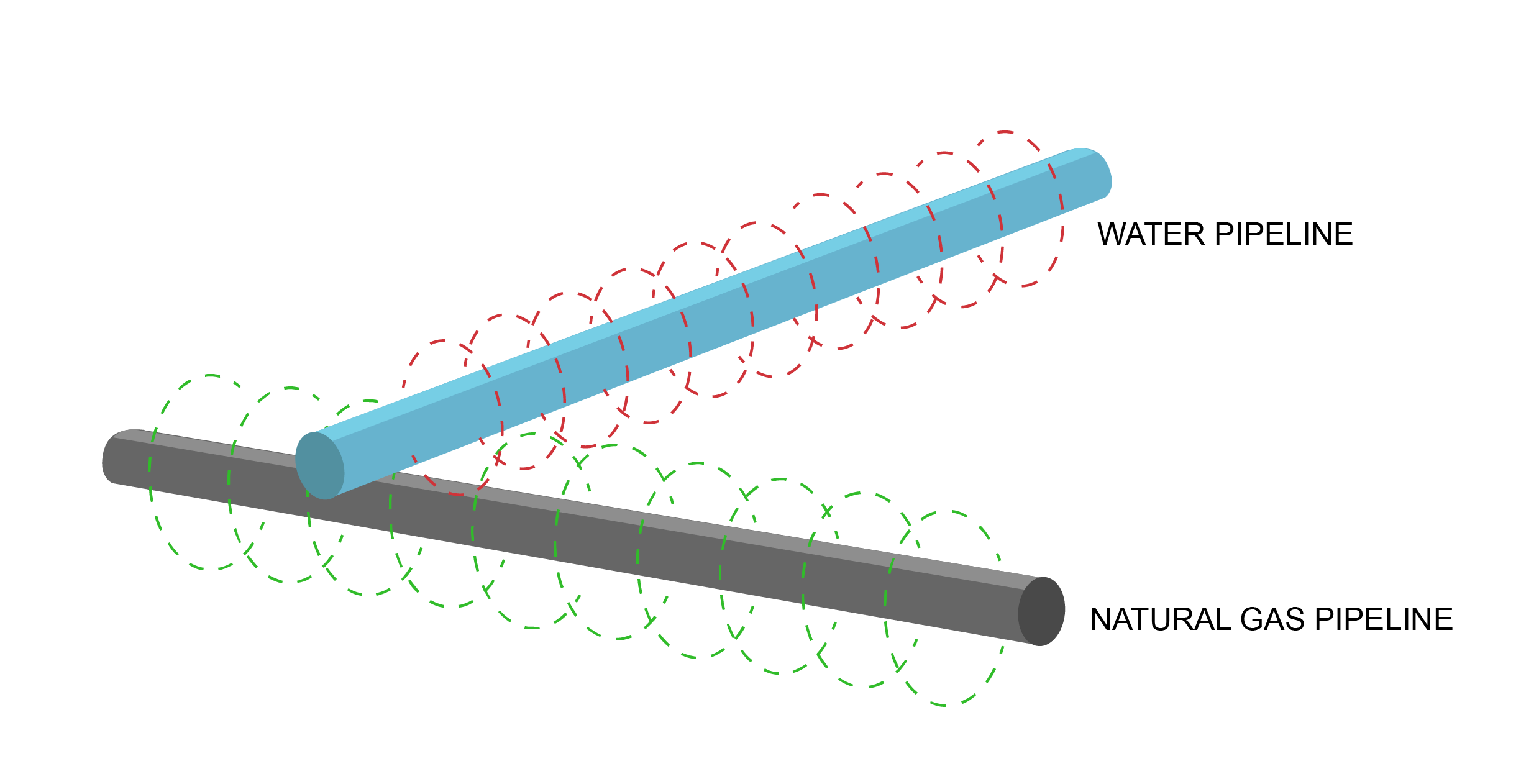
Figure 1. Locator signal travels along a natural gas pipeline and is picked up by a water pipeline
The signal can jump to anything that is physically connected to the pipeline—such as the grounding conductor of a motor operated valve (MOV) or an AC mitigation system. This again can cause the line locater veer off of the intended path. In this instance the signal will not necessarily be weaker, adding difficulty in determining if the pipeline is being followed correctly.
If a locator is following the signal being read from the grounding conductor of an MOV, the locator will discover this once they arrive at the electrical connection. It is more difficult to know if the locator is following the signal being read from the AC mitigation system.

Figure 2. Locator signal passing through a decoupler onto the AC mitigation wire
AC mitigation systems will most likely run in parallel with the pipeline that is being located. These systems are designed to mitigate the steady-state current from transmission towers that typically operate at 60Hz in the United States, or 50Hz outside of the US. Because Dairyland decouplers are designed to have a low impedance, any frequency above 7Hz will pass through the decoupler onto the AC mitigation system. If the locator jumps off the pipeline and begins following the path of the AC mitigation system, it won’t be immediately obvious, as the signal will not appear weaker like it would in the case of it following a foreign water line. This can cause location markings to be off by several feet.
For activities, such as line locating that involve the use a signal varying in frequency, as well as current surveys, ACVG, and DCVG coating surveys-Dairyland recommends installing a disconnect switch to prevent this current from moving onto to the connected AC mitigation system. The use of a disconnect switch is a quick and safe solution in these circumstances. View all Dairyland switches on our product accessories page.
For decouplers that are in an electrical circuit for electrical equipment grounding isolation, we do not recommend the use of a disconnect switch since these circuits should not be open for electrical safety.
If you should have any questions regarding the information in this article, please feel free to contact us at techsupport@dairyland.com.
DAIRYLAND ELECTRICAL INDUSTRIES
RECOMMENDED TORQUE VALUES
The following charts show recommended torque values for all stainless-steel fasteners.
| Fasteners with in.-lbs. values* | |
| Fastener Size | Torque Value |
| #8-32 | 17 in.-lbs. |
| #10-32 | 27 in-lbs. |
| 1/4-20 | 64 in-lbs. |
| 5/16-18 | 112 in.-lbs. |
| 3/8-16 | 201 in.-lbs. |
| 7/16-14 | 302 in.-lbs. |
| Fasteners with ft.-lbs. values* | |
| Fastener Size | Torque Value |
| 1/2-13 | 37 ft.-lbs. |
| 9/16-12 | 48 ft.-lbs. |
| 5/8-11 | 78 ft.-lbs. |
| 3/4-10 | 108 ft.-lbs. |
| 7/8-9 | 165 ft.-lbs. |
| 1-8 | 243 ft.-lbs. |
Metric stainless-steel fasteners to be torqued to Nm values.
| Metric Fasteners with Nm values* | |
| Fastener Size | Torque Value |
| M5 | 4 Nm |
| M6 | 6.5 Nm |
| M8 | 16 Nm |
| M10 | 31 Nm |
| M12 | 54.5 Nm |
| M14 | 87 Nm |
| M16 | 135 Nm |
| M20 | 264 Nm |
For torque values for non-stainless steel, or for fastener sizes not shown above, please refer to fastener supplier or the Machinery’s Handbook for appropriate torque values.
Disclaimer: These torque values are only applicable to fasteners within or directly connected to, Dairyland Electrical Industries products with Dairyland provided fasteners. It is the installer’s responsibility to ensure proper torque values for all other fasteners and/or bolted joints.
* All torque values given for lubricated conditions.
Decouplers are a vital element of most CP systems, providing numerous benefits to their users including blocking the flow of DC current to ground, AC voltage mitigation, over-voltage protection, safety grounding and AC fault current and lightning impulse protection. For 40 years, Dairyland has been providing the industry with leading decoupler technology in the form of the globally used SSD and PCR.
In some circumstances, site conditions and other factors paired with traditional decouplers contribute a capacitive effect to interrupted surveys, which can lead to inaccurate readings and frustration for users. Dairyland has previously discussed solutions to these challenges, including adjustments to the instant-off cycle times or disconnection of the decouplers using the Isolation Switch. The PCRX introduces active capacitance compensation that addresses these challenges without requiring disconnection or other time-consuming methods of remediation.
How Can I Know if the PCRX Will Improve My Surveys?
The capacitance effect that can lead to inaccurate interrupted surveys can be challenging to predict as it involves a variety of factors and site conditions. While Dairyland has done extensive research using internal and external experts, there is not an easy one-size-fits-all answer. However, general guidance in the selection of the decoupler is given below.
Evaluate Site Conditions
Notably, the only decoupler featuring active capacitance compensation during interrupted surveys is the PCRX. When evaluating what product to choose, an expected question arises: How do I know if my site will have this capacitive effect on my interrupted surveys? Due to the wide variety of factors, it is not possible to predict with certainty which sites will experience this issue. However, site conditions play a significant role in whether users will experience the capacitive effect during interrupted surveys with traditional decouplers.
While this cannot be used as a definitive tool, the following chart shows trends indicating the likelihood of this effect occurring based on site conditions. The PCRX will be generally suitable for any site condition. Traditional decouplers like the SSD or PCR are less likely to have a significant effect on interrupted surveys in site conditions indicated on the left of this chart.

Definitive Site Testing

Dairyland’s CAD-270
While an analysis of the product ratings and site conditions is likely adequate for most users, some users may want a more definitive answer to whether their site would exhibit capacitive effects when using traditional decouplers. Dairyland has developed an in-depth process for site testing. See the article ‘Testing and Evaluation of Decoupler Capactive Effects and Utlization of the Dairyland Model PCRX’ for a thorough explanation of this process. By utilizing existing standard decouplers or the new CAD-270 Capacitive Assessment Device, users can gather site data for this determination. A general outline of this site evaluation method is below.

Compare Product Ratings
Dairyland’s range of decouplers all perform the same core functions of providing simultaneous DC isolation and AC grounding. However, there are differences in product ratings and features that should be evaluated when choosing a decoupler for your site conditions. Utilize the chart below to compare decoupler models and determine the most suitable product for your needs.
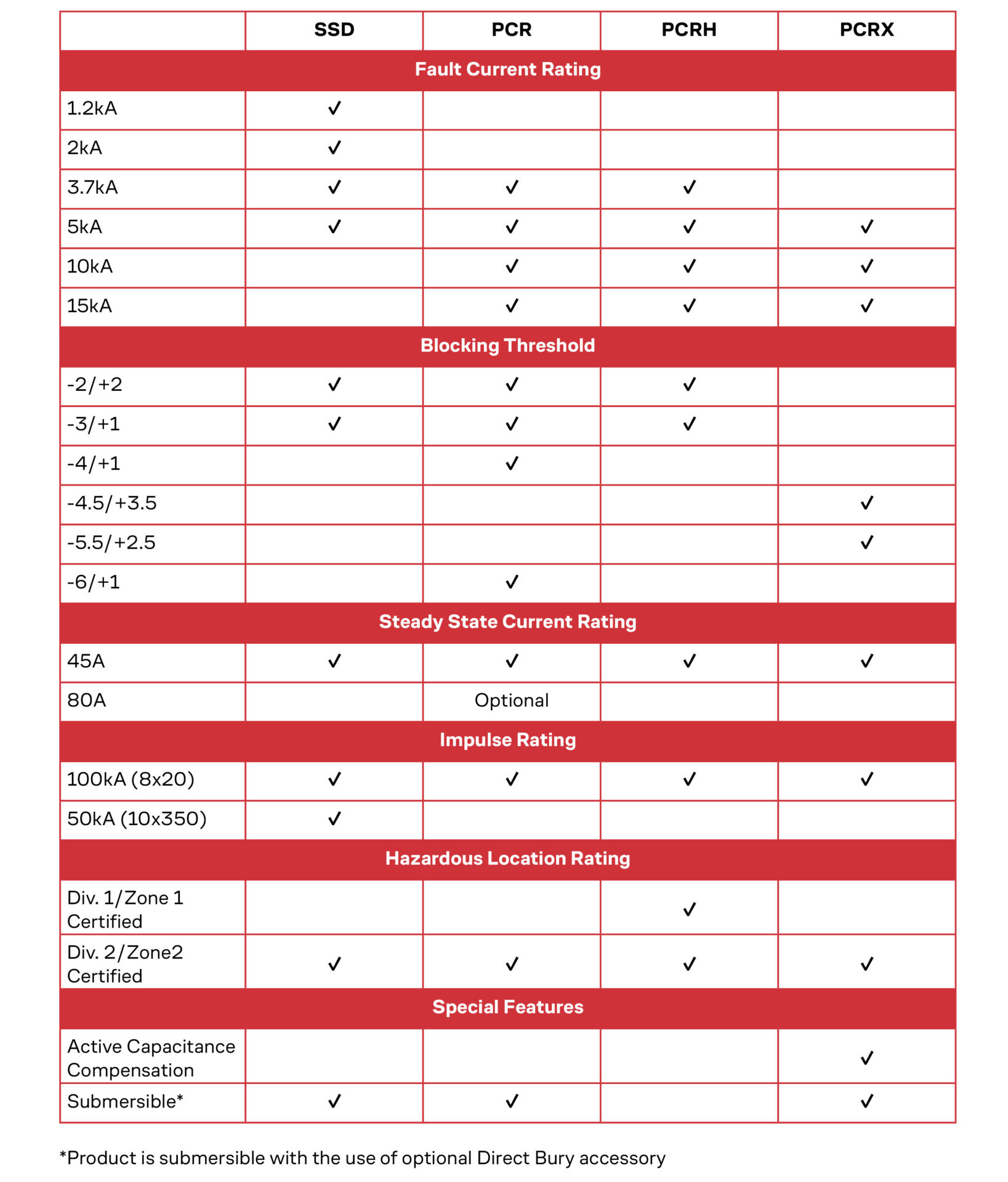
If you are interested in learning more about the PCRX’s features and operating characteristics, please review our PCRX FAQs or contact Dairyland technical support for more information on if the PCRX is right for you.
One Solid Choice: Decouplers vs. Competing Technologies
As a corrosion professional, your ideal applications keep your personnel safe and your system running efficiently. As an installer, you want tech that is easy to install and is maintenance-free. No matter your position, we know you are looking for solutions that address your multiple needs:
- Addressing CP isolation issues
- Mitigating steady-state induced AC current
- Tackling safety grounding issues for things like AC faults or lightning
Not only do you want a device that can handle all of these needs, but also need a product you can trust to perform reliably.
Alternative Technologies
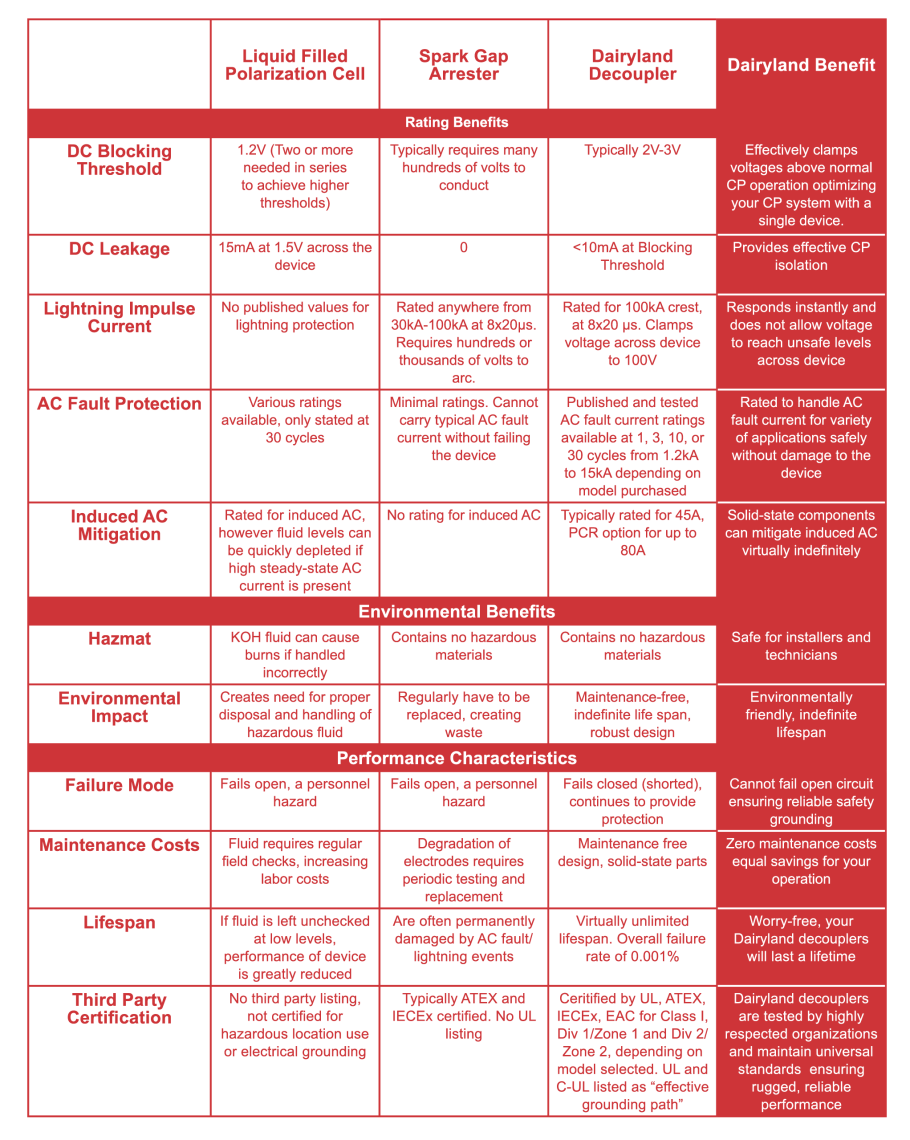
There are several devices on the market that attempt to resolve one or more of these concerns. However, maintenance needs, limited lifespans, and safety concerns all come attached to their price tags. Dairyland decouplers offer a solution to all of your CP isolation and over-voltage protection needs and have a proven track record for their rugged performance. Below, we outline briefly how each technology functions and then compare key qualities between the three technologies.
Liquid-filled polarization cells are designed to block DC current from a cathodic protection system, in order to maintain the effectiveness of the CP system. These devices are made of stainless steel or nickel plates that are immersed in potassium hydroxide electrolyte. When a low DC current is present, the device polarizes the plates and limits the flow. They pass higher voltage DC, steady-state AC, AC faults and lightning current. Regular maintenance of the fluid level is required, especially under conditions where AC steady-state induced current is present to maintain the product’s performance characteristics. This technology is being steadily replaced by more reliable solid-state decoupling devices.
Spark gap arresters are made of two electrodes separated by a gap, usually filled with air. When the voltage between the electrodes exceeds the ability of the air gap to isolate, the current will arc over and flow through the device. They are made to respond to lightning, but usually require several hundreds or thousands of volts to arc. Spark gap devices cannot carry typical AC fault levels for any significant length of time and are not capable of providing AC voltage mitigation.
Solid-state decouplers use electronic switching components to isolate DC current from cathodic protection systems from grounding paths. They also simultaneously provide a safe grounding path for AC fault and lightning events. Under normal operating conditions, the device remains as an open circuit and is able to isolate DC current, while allowing any steady-state AC to flow to ground that may be induced from power lines. During a lightning or AC fault event, the device closes and allows the high current to pass to ground. Following the over-voltage event, the device opens again to return to normal DC isolation mode, an operation that can be repeated virtually indefinitely.
Other Solid-State Decouplers
Since our beginning in 1983, Dairyland has become the premier manufacturer of solid-state decoupling devices around the world. More recently there have been solid-state decouplers introduced by other parties in various countries around the world. While these products have attempted to mimic Dairyland designs, no other product to date has been able to match Dairyland’s performance, or reliability.
Always Rugged.
- Wide variety of performance ratings and environmental ratings
- Unique, proven construction assures maintenance-free operation
- Assured fail-safe design, independently tested
- Proprietary manufacturing methods that assure corrosion resistance, high AC fault capability, and low leakage current
- Extensive third-party certifications for proven performance
Always Reliable.
- Impeccable performance record featuring a .001% failure rate across product lines
- Experienced application and technical support
- Fast, reliable customer service
- Proven, tested manufacturing processes ensuring consistent product quality
- ISO 9001:2015 certified company ensures quality processes from start to finish
With their rugged construction, versatile design and proven reliability, Dairyland’s solid-state decouplers are the smart choice over other DC isolation devices available. Long-term, you will save maintenance labor and material costs by installing Dairyland devices, while mitigating risk to your equipment and personnel.
In addition to manufacturing industry-leading products, we pride ourselves on providing reliable technical support. If we can be of assistance in your applications, please contact our technical support team.
Your Dairyland decoupler will come with polarity labels near the terminals for positive (+) and negative (-) connections. Pay close attention to these, as they can be important depending on the blocking threshold held by your specific model. If the device is incorrectly installed with polarities reversed, the unit could go into conduction and short out CP current during normal operating conditions.

- If you purchased a decoupler with a symmetrical DC blocking threshold rating such as -2/+2V, you may connect the terminals in either configuration regardless of polarity.
- If you purchased a decoupler with an asymmetrical configuration such as a -3/+1 configuration, you will need to connect the negative terminal to the cathodically protected structure and the positive terminal to the grounded side, if one side is grounded.
- If you have cathodic protection on both sides of anisolation joint, connect the negative terminal to the more electro-negative side. Connect the positive terminal to the side of the flange that is less negative.
For Dairyland PCRH, PCRX, OVP, and ISP devices, the metallic enclosure is electrically bonded to the positive terminal. So, if mounting these devices onto metallic supports, be aware that the support will also be bonded to the positive terminal. When using your decoupler for lightning protection, remember to always connect the decoupler to the flange with the shortest possible lead length.
If you have further questions about installation and proper placement, please contact our technical support team.
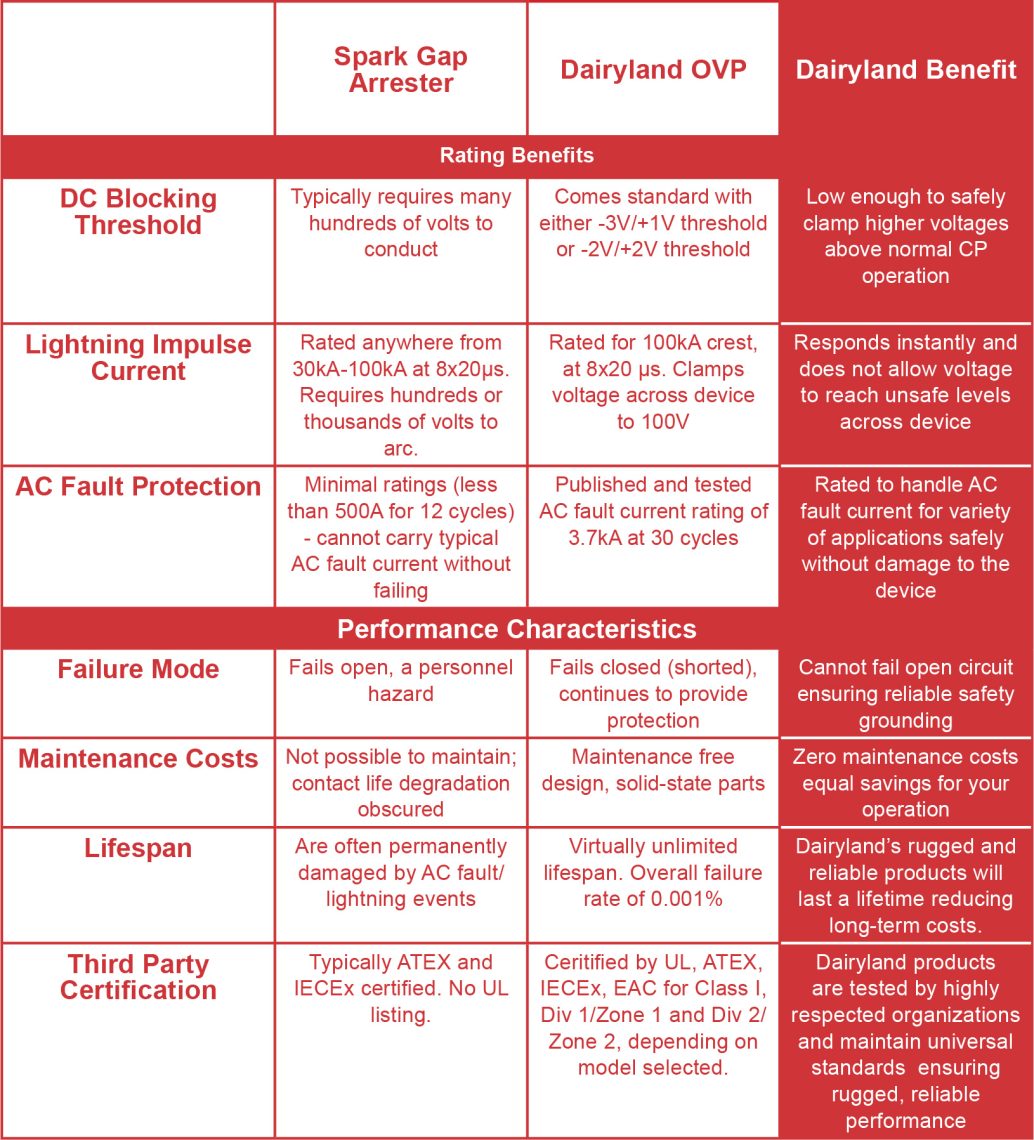
Insulated joints are a crucial part of any operation where corrosion protection is needed, and they need a high level of current protection from lightning strikes and AC faults. If you have a larger application, you will have many joints that require over-voltage protection, both for your personnel and the joint itself. Spark gaps have often been used as lightning protection devices and do provide DC blocking. However, they fall short of an efficient, reliable, and safe solution when compared to more robust devices, due to their failure rate and replacement needs.
Enter the Dairyland Over-Voltage Protector. Our proven, solid-state design is the true solution for over-voltage concerns. Not only will you extend the life of your insulated joints by providing rugged, failsafe protection, you will be installing maintenance-free devices that have virtually unlimited lifespans. No need to schedule maintenance or budget for replacements; the OVP will still be there when you retire. Below, we outline several benefits Dairyland products can offer over gap arresters.
Device Operation
Spark gap arresters are made of two electrodes separated by a gap, usually filled with air. When the voltage between the electrodes exceeds the ability of the air gap to isolate, the current will arc over and flow through the device. They are made to respond to lightning, but usually require several hundreds or thousands of volts to arc. Spark gap devices cannot carry typical AC fault levels for any significant length of time and are not suitable for use with AC mitigation systems.
Dairyland’s Over-Voltage Protectors (OVP and OVP2) use high power solid-state electronic switching components to isolate DC current in cathodic protection systems from grounding paths. They also simultaneously provide a safe grounding path for AC fault and lightning events. Normally, the device remains open and isolates DC current to a specified threshold. During a lightning or AC fault event, the device closes and allows the high current to pass to ground. Once the over-voltage event has cleared, the device returns to normal DC isolation mode. This operation can be repeated virtually indefinitely. OVP devices are not recommended where steady-state AC exists between the connection points. For that specific application, we recommend a decoupler product like the SSD, PCR or PCRH, which are designed to mitigate induced AC.
Depending on your needs, Dairyland’s OVP or OVP2 will supply long-term protection of your equipment and personnel. If your application is in a Divison 1/Zone 1 hazardous location, choose OVP for its explosion-proof housing and rugged construction. If you are installing the unit in a Division 2/Zone 2 or non-hazardous location and just need an over-voltage protector for your insulated joints, but don’t have any AC mitigation needs, go with OVP2. Its solid-state components and fail-safe design will ensure a safe environment for your team members, efficient isolation and grounding for your equipment, and peace of mind for you.
In this updated Decoupler 101 series, we’ll cover the basics of decouplers. You’ll find discussions on what solid-state DC decouplers are, how they are used, a discussion on understanding model numbers and other decoupling basics.
4) Selecting the Right Decoupler