
Dairyland decouplers are used for a variety of purposes, in a wide variety of applications including AC Mitigation, Insulated Joint Protection and Decoupling Electric Equipment. In this short video, we’ll take a closer look at what a decoupler does and how it works. We’ll also look at some of the key features of Dairyland products.
Application Overview
Dairyland decouplers are recommended any time it is necessary to isolate direct current (DC, e.g. cathodic protection current) while simultaneously allowing a path to ground for alternating current (AC) faults and lightning-induced over-voltage events. The primary application of a decoupler is electrical isolation of cathodically protected structures from AC mitigation systems, facility grounding systems or adjacent metallic infrastructure.
Cathodic Protection
In the oil and gas industries, metallic structures (such as pipelines and storage tanks) require corrosion protection through the application of cathodic protection (CP) systems. These systems typically use rectifiers to deliver DC to the metallic structure, shifting its electrical potential in the negative direction to a level that effectively prevents corrosion. By maintaining the structure at a sufficiently negative potential relative to the surrounding soil or electrolyte, the electrochemical reactions that cause corrosion are suppressed, significantly extending asset service life and preventing costly failures.
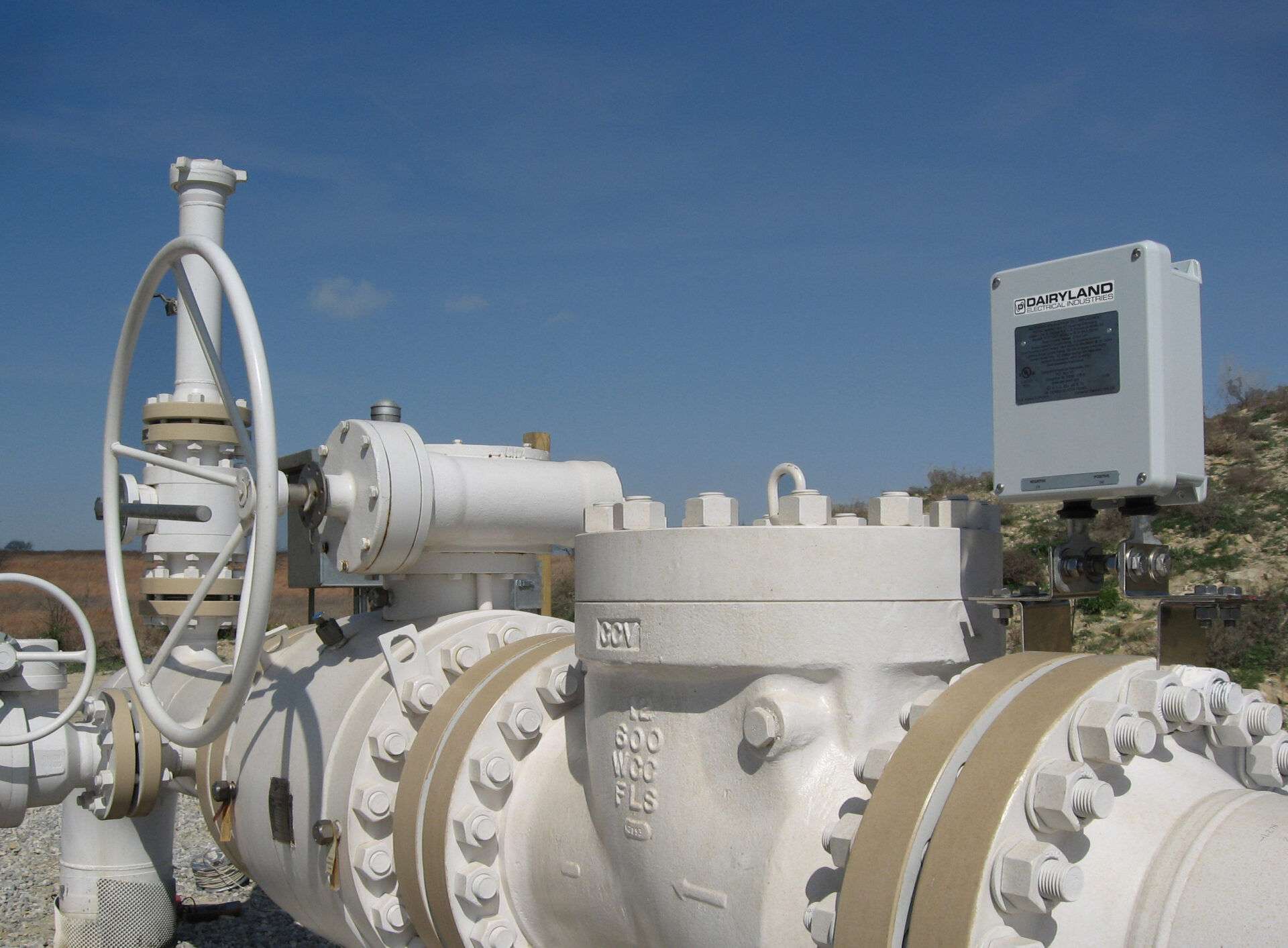
Dairyland PCR installed on an insulated joint
The effectiveness of a cathodic protection system depends on maintaining consistent current flow to all areas of the protected structure. Any unintended current pathways can compromise this protection, leaving portions of the asset vulnerable to corrosion damage. This is particularly critical in pipeline systems where even localized corrosion can lead to leaks, environmental contamination, and safety hazards.
Electrical Safety Requirements
Corrosion control professionals are also responsible for protecting personnel from electrical hazards, including overvoltage conditions caused by lightning strikes and AC fault events. Compliance with these safety requirements mandates effective grounding of electrical equipment and protecting people from touch and step voltages. Proper electrical equipment grounding provides a low-resistance path for fault currents and lightning to dissipate safely into the earth while also limiting dangerous touch and step voltages that could harm personnel working on or near the equipment or above grade piping.
The Grounding-CP Conflict
These two goals, effective cathodic protection and electrical safety grounding, are inherently at odds. Grounding systems create unintended current pathways that divert cathodic protection current away from the protected structure to ground grids or other electrically connected infrastructure. This drains the cathodic protection current and frequently prevents the structure from achieving the negative potential levels required for adequate corrosion control. In severe cases, the CP system may become entirely ineffective, leaving critical assets vulnerable to accelerated corrosion and premature failure.
The challenge is further complicated in facilities where multiple grounded systems converge, such as pipeline crossings near electrical substations or interconnected facility piping networks. In these environments, CP current can be drained through multiple pathways, making it nearly impossible to maintain adequate protection without a decoupling solution.
The Decoupler Solution
Decouplers resolve this conflict through solid-state technology that enables safe grounding of structures while preserving cathodic protection effectiveness. The device blocks DC current flow (preventing CP current loss) while maintaining electrical continuity for AC fault currents and lightning transients. This functionality—known as “decoupling”—can be defined as: utilizing a device that isolates direct current while simultaneously providing a low-impedance path for electrical safety grounding.

Common Decoupler Applications
DC decouplers are utilized across a range of critical applications, including:
- Isolation of electrical equipment from grounding systems while maintaining compliance with electrical safety codes
- Overvoltage protection for insulated pipeline joints
- Connecting cathodically protected pipelines to AC mitigation systems
- Bonding cathodically protected pipelines to gradient control mats
- Connecting cathodically protected power cable sheaths and casings to substation grounding grids
- Separating cathodically protected facilities from utility grounding systems at service transformer locations
Read more to learn which Dairyland Decoupler is best for your specific application needs.
Still have questions? Contact our tech support team at techsupport@dairyland.com or call 608-877-9900 and we’ll help you find the right solution to your problem.
Solid-state decouplers are widely used in the energy industry. But many people don’t understand what they are, how they function and the many ways in which they can be used. This article will arm you with a basic understanding of decouplers – in layman’s terms.
Cathodic Protection
DC Decouplers are often used in conjunction with Cathodic Protection (CP) systems, which are commonly applied on underground pipelines or other metallic structures to prevent galvanic corrosion. A CP system provides corrosion protection by applying a low voltage negative DC bias to the structure. However, required safety grounding systems connected to the structure short this CP current to ground and can compromise the efficiency of the CP system.
Decouplers simultaneously perform two needed electrical functions: DC isolation and AC grounding. Installed between the protected structure and the grounding system, they isolate, or block the flow of DC current (from the CP system) to the grounding system or other equipment, thereby eliminating any negative influence on the CP system caused by the grounding system or neighboring equipment. Yet decouplers also provide safety grounding protection from AC faults and lightning.
How Do Decouplers Work?
A modern decoupler consists of solid-state electronics in parallel with a large capacitor. The solid-state portion acts like a switch (but without any moving parts) that remains open during normal operating conditions to prevent DC from passing and automatically closes during over-voltage conditions, such as AC faults or lightning. When the over-voltage condition passes, the device opens back up and continues to provide DC isolation. The capacitor allows steady state AC current to pass continuously with very low AC voltage drop.
What Protection Do Decouplers Provide?
AC fault protection: AC fault current generated by a failure of nearby equipment is a safety hazard. This AC current can be transmitted via the pipeline, endangering nearby workers, or causing damage to your pipeline. When an AC fault occurs, the decoupler instantly conducts fault current to ground, carrying AC current away from the pipeline and lowering the AC voltage on the pipeline.
Lightning protection: When a lightning strike occurs, it can present a safety hazard to personnel and pose a risk to nearby pipelines. The decoupler behaves in the same way as it does during an AC fault. It safely channels the high voltage current of the lightning to ground, protecting nearby workers and the pipeline. As soon as this event has ended, the decoupler automatically switches back to its DC isolation/cathodic protection role.
Mitigation of induced AC current: Many pipelines are buried along a shared right-of-way with overhead high-voltage power lines. Even during normal operating conditions, current from these power lines induces AC current in the nearby pipeline. This is not only a safety hazard to workers but can also cause corrosion issues. Decouplers such as the PCRX, PCR and SSD are designed to continuously conduct induced AC current to ground, mitigating this risk while simultaneously isolating your CP system.
The sketch below illustrates how decouplers are applied to AC mitigation systems.
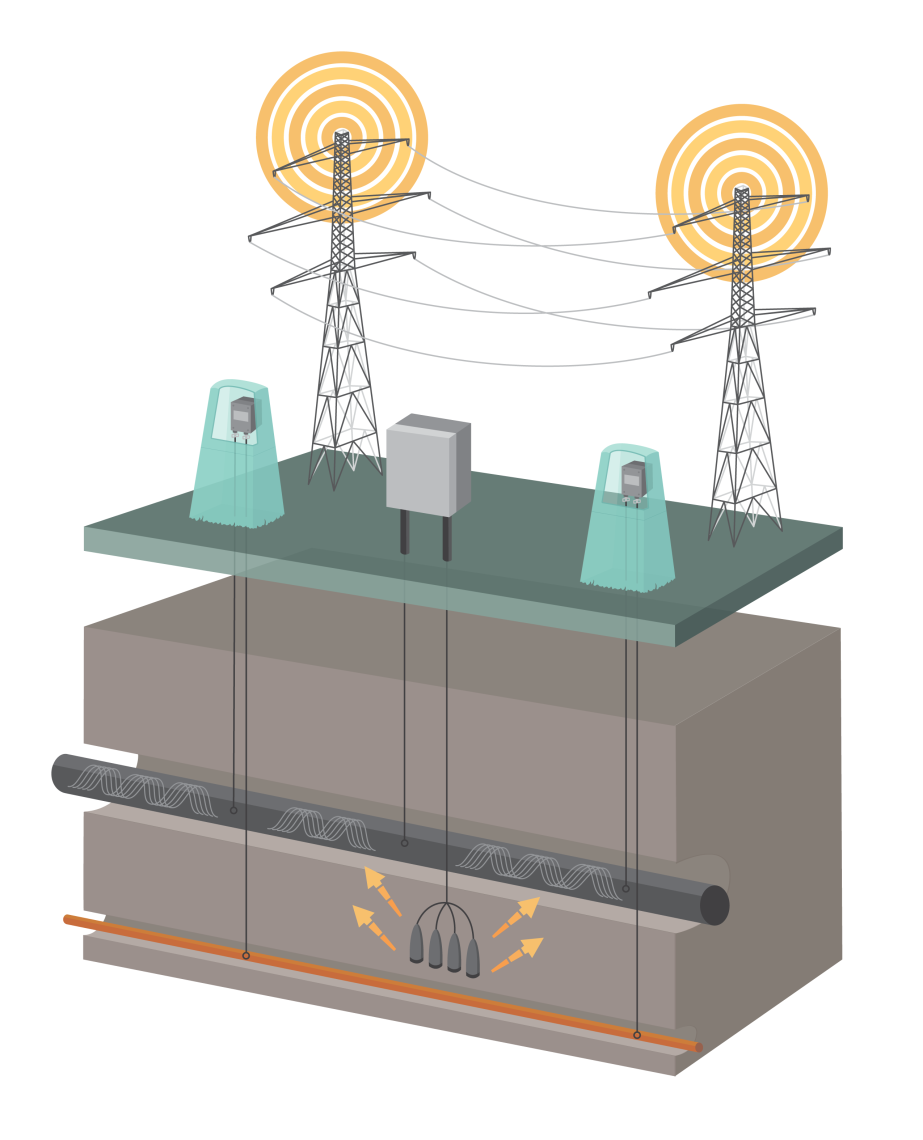
A zinc or copper mitigation wire is laid next to the buried pipeline and is electrically connected to it. The job of the mitigation wire is to safely channel induced AC to ground and reduce the AC voltage on the pipeline. But this creates a challenge for cathodic protection: Because the mitigation wire is electrically connected to the pipeline, the cathodic protection system must now protect both the pipeline and the bare mitigation wire, which requires significantly more CP current and may result in inadequate cathodic protection of the pipeline.
Installing decouplers between the pipeline and the mitigation wire, as shown, isolates the two during normal operation to ensure proper cathodic protection, while simultaneously providing safety grounding and mitigation of induced AC.
Other Electrical Applications
In addition to buried pipelines, decouplers are used to provide similar protection in numerous other applications, including:
- Decoupling tank grounding systems
- Decoupling electrical equipment grounding systems
- Insulated joint protection of pipelines
- Airport fueling systems
- AC voltage mitigation
- Decoupling from utility grounding systems
- Marine galvanic isolation
- Stray voltage mitigation
- Decoupling power cable sheaths/casings
- Gradient control mat decoupling
To learn more about these applications, please click on the links above. For a more detailed introduction to decouplers, please view our Decoupler 101 video series.
Questions?
Please contact Dairyland using our contact us form or at (608) 877-9900 with any questions about solid-state decouplers, cathodic protection or over-voltage protection.
Imagine a world where solid-state decouplers never existed. What would be the effects on pipelines and the workers who maintain them? To better understand the critical roles decouplers play on modern pipelines, let’s take a closer look at the impacts of this imaginary scenario.
Cathodic protection
The role of decouplers in cathodic protection (CP): A CP system provides corrosion protection by applying a low voltage negative DC bias to the structure. However, required safety grounding systems connected to the structure short this CP current to ground and can compromise the efficiency of the CP system.
Under normal circumstances, the decoupler functions to isolate or block the flow of DC current (cathodic protection) to other equipment or grounding material. Decoupling eliminates any negative influence on your CP system caused by neighboring equipment or grounding materials. Therefore, it improves the performance of your CP system.
If decouplers didn’t exist: Without decouplers, pipeline owners would face complex and costly challenges to achieving adequate levels of CP on their pipelines due to direct bonded grounding material and proximity to other nearby structures and equipment. Inadequate CP increases the chance of defects, leaks and other problems caused by corrosion on your asset. The cost of corrosion is extremely high and is well documented by the National Association of Corrosion Engineers (NACE).
Solid-state decouplers are an essential component of any cathodic protection system. They allow simultaneous DC isolation and AC grounding. That allows pipeline operators to improve the performance of their CP system while remaining grounded for safety.
Performance Characteristics
In addition to improving the performance of CP systems, decouplers are carefully designed to handle critical site conditions to ensure proper performance of the device and maintain worker safety. These important performance features include:
- AC fault current generated by a failure of nearby equipment represents a safety hazard. This fault current can be transmitted via the pipeline, endangering nearby workers or causing damage to the pipeline. When an AC fault occurs, the decoupler instantly conducts fault current to ground, carrying AC current away from the pipeline and providing instant protection. Products must be properly and adequately rated for fault current to ensure proper product performance.
- Lightning protection: When a lightning strike occurs, it can be a safety hazard to personnel and can pose a risk to the pipeline. Dairyland decouplers feature high lightning current ratings so that they can safely channel the lightning current to ground, protecting nearby workers and the structure itself from high voltage. As soon as this event has ended, the decoupler automatically switches back to its DC isolation/cathodic protection role. Lightning current ratings should be properly tested and certified by third-party laboratories to ensure product performance under these brief but extreme conditions.
- Mitigation of induced AC current: Many pipelines are buried along a shared right-of-way with high-voltage power lines, which induce AC current in the pipeline. This is not only a safety hazard to workers but can also cause significant damage from AC corrosion. Decouplers are designed to continuously conduct induced AC current to ground, mitigating this risk while simultaneously isolating the pipeline’s CP system. Proper product selection is critical when induced AC is a concern, as some industry products are not capable of adequately handling steady-state AC current.
- Fail-safe design: While the failure rate of Dairyland decouplers is extremely low (small fractions of a percent), they are designed as “fail-safe.” This ensures that in the unlikely event of a product failure, the product always fails short circuit, thereby ensuring continuity of your safety grounding. Other products that fail open-circuit can create dangerous safety hazards, in addition to requiring regular maintenance and replacement.
In conclusion, thank goodness solid-state decouplers DO exist. Solid-state decouplers allow for simultaneous optimization of a CP system through DC isolation, as well as providing a continuous path to ground for safety. While other products can perform elements of these functions, Dairyland decouplers have the performance history, third-party certifications and design features required to ensure reliability for the duration of their use.
To learn more about decouplers and the critical roles they play on modern pipelines, please read this article on the Dairyland Knowledge Base: What Are Solid-State Decouplers and How Are They Used?
Decouplers are critical for protecting expensive assets, and for the safety of personnel and the public. If they fail, pipelines, tanks and other CP-protected structures can be left exposed to AC interference and over-voltage hazards, which can endanger people and permanently damage equipment. So, when purchasing decoupler products you need to be certain that you can count on them to perform as specified. Dairyland has always been known for the reliability of our products. Having provided decouplers and over-voltage protection equipment for 40 years with virtually no failures allows us to claim that our products are truly rugged and reliable. But don’t take just our word for it – rely on our third-party certifications to independently confirm that our products do what we say they do.
Dairyland maintains an extensive list of internationally accepted third-party product certifications where electrical or other safety codes apply. Maintaining certifications is expensive and time-consuming. Others avoid it, but we insist on it because it’s important. Each of our PCR, SSD, PCRH, OVP and OVP2 models have the following certifications:
- Underwriter’s Laboratories (UL) in the U.S. and Canada:
- Assures the validity of all product ratings including: AC Fault Current, Lightning Current, Steady-State AC Current, DC Blocking Threshold and Environmental Exposure
- Fail-Safe Performance – Tested to National Electric Code Requirements for an “effective ground path”. See this related article for more information on Verified AC Fault Current Ratings and Fail-Safe Performance.
- Approvals for hazardous location use
- Numerous other certifications that provide similar assurances of performance and safety from certification bodies around the world, including CE, ATEX, IECEX, EAC and CNEx.

In addition, our quality certifications, ISO 9001:2015 and ISO/IEC 80079-34, require periodic company-wide quality audits, ensuring that nearly all processes throughout our company, from design to manufacturing to customer service, meet strict quality requirements. These quality certifications, together with our long list of product certifications, provide our customers with confidence that Dairyland products will reliably meet the requirements of their most challenging applications without having to spend time and money to perform additional validation testing.
By using products without appropriate third-party certifications, customers run a high risk that the products will not perform to their stated specifications or fail, leading to high replacement costs, safety issues and the need for frequent in-field inspection and testing.
Decoupler users throughout the industry should look for products certified by independent third parties to meet all critical performance requirements, fail-safe operation and application in hazardous locations to ensure product performance, long life and safety.
- Previous Page
- Page1
- Page2